In the Circuit Shown Below, Voltmeter V2 Reads 80. Volts. What Is the Reading of Voltmeter V1?
Learning Objectives
Past the end of this section, you will be able to:
- Explain why a voltmeter must be continued in parallel with the circuit.
- Draw a diagram showing an ammeter correctly connected in a circuit.
- Describe how a galvanometer tin can be used as either a voltmeter or an ammeter.
- Discover the resistance that must be placed in serial with a galvanometer to allow information technology to be used equally a voltmeter with a given reading.
- Explicate why measuring the voltage or current in a circuit tin can never exist exact.
Voltmeters measure out voltage, whereas ammeters measure out current. Some of the meters in automobile dashboards, digital cameras, cell phones, and tuner-amplifiers are voltmeters or ammeters. (See Effigy i.) The internal construction of the simplest of these meters and how they are continued to the organization they monitor give further insight into applications of series and parallel connections.
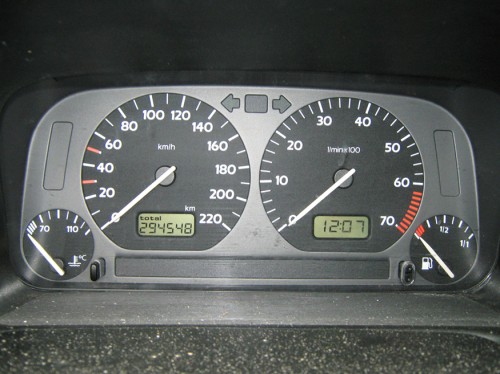
Effigy 1. The fuel and temperature gauges (far right and far left, respectively) in this 1996 Volkswagen are voltmeters that register the voltage output of "sender" units, which are hopefully proportional to the amount of gasoline in the tank and the engine temperature. (credit: Christian Giersing)
Voltmeters are continued in parallel with whatever device'southward voltage is to exist measured. A parallel connectedness is used because objects in parallel experience the same potential difference. (See Figure 2, where the voltmeter is represented past the symbol Five.) Ammeters are connected in serial with any device'south current is to be measured. A series connection is used because objects in serial take the same current passing through them. (See Figure 3, where the ammeter is represented by the symbol A.)
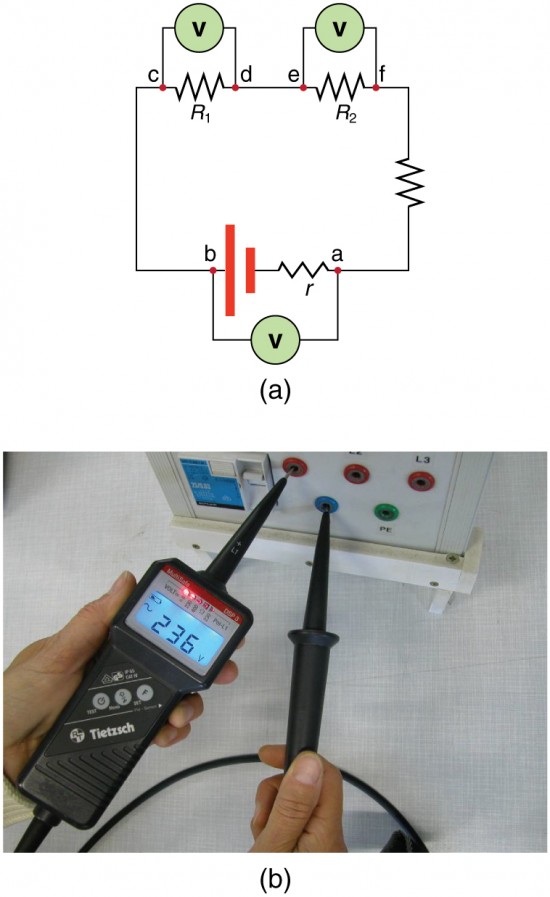
Figure 2. (a) To mensurate potential differences in this series circuit, the voltmeter (V) is placed in parallel with the voltage source or either of the resistors. Notation that terminal voltage is measured between points a and b. It is not possible to connect the voltmeter directly across the emf without including its internal resistance, r. (b) A digital voltmeter in use. (credit: Messtechniker, Wikimedia Commons)
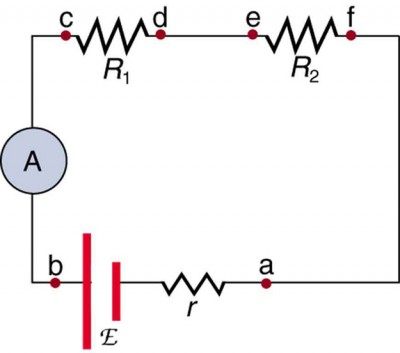
Figure 3. An ammeter (A) is placed in series to mensurate current. All of the current in this excursion flows through the meter. The ammeter would accept the same reading if located between points d and due east or between points f and a as information technology does in the position shown. (Note that the script upper-case letter East stands for emf, and r stands for the internal resistance of the source of potential difference.)
Analog Meters: Galvanometers
Analog meters have a needle that swivels to indicate at numbers on a scale, as opposed to digital meters, which have numerical readouts similar to a hand-held calculator. The centre of virtually analog meters is a device called a galvanometer, denoted by K. Current flow through a galvanometer, I One thousand, produces a proportional needle deflection. (This deflection is due to the force of a magnetic field upon a current-carrying wire.)
The two crucial characteristics of a given galvanometer are its resistance and current sensitivity. Current sensitivity is the current that gives a total-scale deflection of the galvanometer's needle, the maximum current that the instrument can measure. For instance, a galvanometer with a current sensitivity of 50 μA has a maximum deflection of its needle when 50 μA flows through it, reads half-calibration when 25 μA flows through it, and and so on. If such a galvanometer has a 25-Ω resistance, and then a voltage of simplyV = IR = (l μA)(25 Ω) = 1.25 mV produces a full-scale reading. Past connecting resistors to this galvanometer in different ways, you tin can employ it equally either a voltmeter or ammeter that can measure a broad range of voltages or currents.
Galvanometer as Voltmeter
Figure 4 shows how a galvanometer tin be used as a voltmeter past connecting it in series with a large resistance, R. The value of the resistance R is adamant by the maximum voltage to be measured. Suppose you want 10 5 to produce a full-scale deflection of a voltmeter containing a 25-Ω galvanometer with a 50-μA sensitivity. And then 10 V applied to the meter must produce a current of 50 μA. The total resistance must exist
[latex]{R}_{\text{tot}}=R+r=\frac{V}{I}=\frac{ten\text{ V}}{50\text{ }\mu \text{A}}=200\text{ yard}\Omega\\[/latex] or
[latex]R={R}_{\text{tot}}-r=200\text{ one thousand}\Omega-25\text{ }\Omega \approx 200\text{ yard}\Omega \\[/latex].
(R is so big that the galvanometer resistance, r, is nearly negligible.) Note that v Five practical to this voltmeter produces a half-scale deflection by producing a 25-μA current through the meter, and so the voltmeter'southward reading is proportional to voltage as desired. This voltmeter would not be useful for voltages less than about half a volt, because the meter deflection would be small and difficult to read accurately. For other voltage ranges, other resistances are placed in series with the galvanometer. Many meters take a choice of scales. That choice involves switching an appropriate resistance into serial with the galvanometer.

Figure 4. A large resistance R placed in series with a galvanometer M produces a voltmeter, the total-calibration deflection of which depends on the choice of R. The larger the voltage to be measured, the larger R must be. (Note that r represents the internal resistance of the galvanometer.)
Galvanometer as Ammeter
The same galvanometer tin can besides be fabricated into an ammeter by placing information technology in parallel with a small resistance R, oftentimes called the shunt resistance, every bit shown in Figure 5. Since the shunt resistance is small, most of the current passes through information technology, assuasive an ammeter to measure out currents much greater than those producing a total-calibration deflection of the galvanometer. Suppose, for example, an ammeter is needed that gives a total-calibration deflection for 1.0 A, and contains the same 25-Ω galvanometer with its 50-μA sensitivity. Since R and r are in parallel, the voltage across them is the aforementioned. These IR drops areIR = I G r and then that [latex]IR=\frac{{I}_{\text{M}}}{I}=\frac{R}{r}\\[/latex]. Solving for R, and noting that I 1000 is 50 μA and I is 0.999950 A, we have
[latex]R=r\frac{{I}_{\text{G}}}{I}=\left(25\text{ }\Omega\right)\frac{50\text{ }\mu\text{A}}{0.999950\text{ A}}=ane.25\times 10^{-iii}\text{ }\Omega\\[/latex].
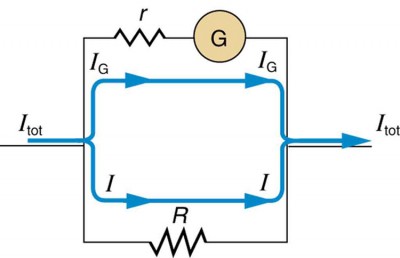
Effigy v. A small shunt resistance R placed in parallel with a galvanometer G produces an ammeter, the full-scale deflection of which depends on the choice of R. The larger the current to be measured, the smaller R must be. Most of the current (I) flowing through the meter is shunted through R to protect the galvanometer. (Notation that r represents the internal resistance of the galvanometer.) Ammeters may as well take multiple scales for greater flexibility in awarding. The various scales are achieved by switching various shunt resistances in parallel with the galvanometer—the greater the maximum electric current to exist measured, the smaller the shunt resistance must be.
Taking Measurements Alters the Circuit
When you utilise a voltmeter or ammeter, y'all are connecting another resistor to an existing circuit and, thus, altering the circuit. Ideally, voltmeters and ammeters do non appreciably affect the circuit, just information technology is instructive to examine the circumstances under which they do or do not interfere. Commencement, consider the voltmeter, which is ever placed in parallel with the device existence measured. Very little current flows through the voltmeter if its resistance is a few orders of magnitude greater than the device, and so the circuit is non appreciably affected. (See Figure vi(a).) (A large resistance in parallel with a small 1 has a combined resistance essentially equal to the small i.) If, however, the voltmeter'southward resistance is comparable to that of the device beingness measured, and so the ii in parallel have a smaller resistance, appreciably affecting the circuit. (Run across Effigy 6(b).) The voltage beyond the device is not the same as when the voltmeter is out of the excursion.
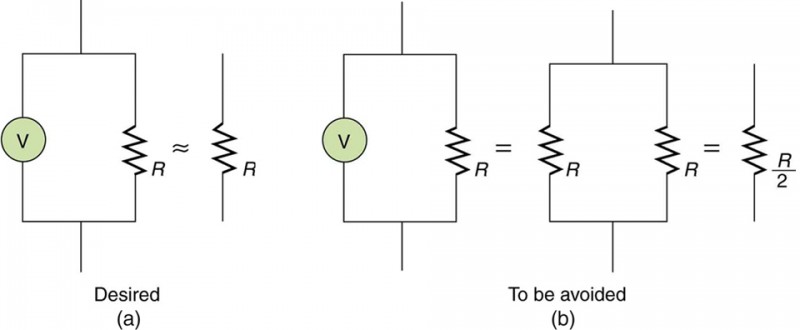
Figure half-dozen. (a) A voltmeter having a resistance much larger than the device (RVoltmeter>>R) with which information technology is in parallel produces a parallel resistance essentially the same as the device and does not appreciably affect the circuit being measured. (b) Here the voltmeter has the aforementioned resistance as the device (RVoltmeter≅R), so that the parallel resistance is half of what information technology is when the voltmeter is not connected. This is an case of a significant amending of the excursion and is to be avoided.
An ammeter is placed in series in the branch of the circuit being measured, so that its resistance adds to that co-operative. Normally, the ammeter'due south resistance is very small compared with the resistances of the devices in the excursion, and so the extra resistance is negligible. (See Figure 7(a).) Notwithstanding, if very small load resistances are involved, or if the ammeter is not equally low in resistance every bit it should be, then the total serial resistance is significantly greater, and the current in the co-operative being measured is reduced. (See Effigy 7(b).) A applied problem can occur if the ammeter is connected incorrectly. If it was put in parallel with the resistor to measure the current in information technology, you could possibly impairment the meter; the low resistance of the ammeter would allow most of the current in the circuit to get through the galvanometer, and this current would be larger since the effective resistance is smaller.
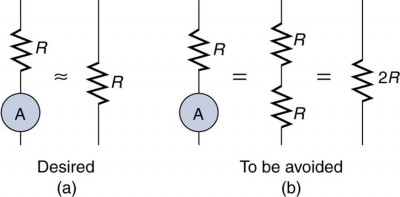
Figure vii. (a) An ammeter ordinarily has such a pocket-size resistance that the total series resistance in the branch being measured is not appreciably increased. The excursion is substantially unaltered compared with when the ammeter is absent. (b) Here the ammeter's resistance is the same as that of the branch, so that the full resistance is doubled and the current is half what it is without the ammeter. This significant amending of the circuit is to be avoided.
One solution to the problem of voltmeters and ammeters interfering with the circuits being measured is to employ galvanometers with greater sensitivity. This allows construction of voltmeters with greater resistance and ammeters with smaller resistance than when less sensitive galvanometers are used. There are applied limits to galvanometer sensitivity, but information technology is possible to become analog meters that make measurements accurate to a few pct. Notation that the inaccuracy comes from altering the circuit, not from a fault in the meter.
Connections: Limits to Cognition
Making a measurement alters the system being measured in a style that produces uncertainty in the measurement. For macroscopic systems, such equally the circuits discussed in this module, the alteration tin can usually be made negligibly small, but information technology cannot exist eliminated entirely. For submicroscopic systems, such as atoms, nuclei, and smaller particles, measurement alters the organisation in a style that cannot exist fabricated arbitrarily small. This actually limits noesis of the system—even limiting what nature can know about itself. We shall see profound implications of this when the Heisenberg dubiousness principle is discussed in the modules on quantum mechanics.
There is another measurement technique based on cartoon no electric current at all and, hence, not altering the circuit at all. These are chosen goose egg measurements and are the topic of Null Measurements. Digital meters that employ solid-state electronics and null measurements can reach accuracies of one role in 10six.
Check Your Understanding
Digital meters are able to detect smaller currents than analog meters employing galvanometers. How does this explain their ability to measure out voltage and electric current more accurately than analog meters?
Solution
Since digital meters require less current than analog meters, they modify the circuit less than analog meters. Their resistance as a voltmeter can be far greater than an analog meter, and their resistance as an ammeter tin can be far less than an analog meter. Consult Figure 2 and Figure 3 and their discussion in the text.
PhET Explorations: Circuit Construction Kit (DC Only), Virtual Lab
Stimulate a neuron and monitor what happens. Pause, rewind, and move forward in time in order to notice the ions as they movement across the neuron membrane.

Click to download the simulation. Run using Coffee.
Section Summary
- Voltmeters measure voltage, and ammeters measure current.
- A voltmeter is placed in parallel with the voltage source to receive full voltage and must have a large resistance to limit its outcome on the excursion.
- An ammeter is placed in series to get the total current flowing through a co-operative and must accept a minor resistance to limit its upshot on the excursion.
- Both can be based on the combination of a resistor and a galvanometer, a device that gives an analog reading of current.
- Standard voltmeters and ammeters modify the circuit being measured and are thus limited in accurateness.
Conceptual Questions
1. Why should you not connect an ammeter direct across a voltage source as shown in Figure ix? (Note that script E in the effigy stands for emf.)
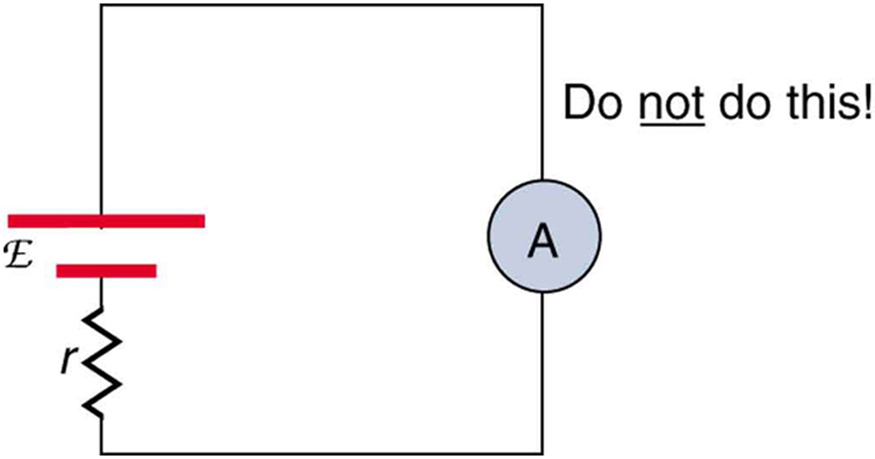
Effigy 9.
2. Suppose you lot are using a multimeter (i designed to measure a range of voltages, currents, and resistances) to mensurate current in a excursion and you inadvertently leave it in a voltmeter way. What upshot volition the meter take on the circuit? What would happen if you lot were measuring voltage but accidentally put the meter in the ammeter manner?
three. Specify the points to which you could connect a voltmeter to measure out the post-obit potential differences in Effigy x: (a) the potential difference of the voltage source; (b) the potential difference across R 1; (c) acrossR 2; (d) beyondR three; (due east) acrossR two andR 3. Note that in that location may be more than than 1 answer to each part.

Figure ten.
four. To measure out currents in Figure 10, you would replace a wire between two points with an ammeter. Specify the points between which you would place an ammeter to mensurate the following: (a) the total current; (b) the current flowing throughR 1; (c) throughR 2; (d) throughR 3. Annotation that at that place may be more one answer to each office.
Bug & Exercises
1. What is the sensitivity of the galvanometer (that is, what current gives a full-scale deflection) inside a voltmeter that has a 1.00-MΩ resistance on its xxx.0-V scale?
two. What is the sensitivity of the galvanometer (that is, what current gives a full-calibration deflection) inside a voltmeter that has a 25.0-kΩ resistance on its 100-V calibration?
three. Detect the resistance that must be placed in series with a 25.0-Ω galvanometer having a50.0 -μA sensitivity (the same equally the one discussed in the text) to allow it to be used as a voltmeter with a 0.100-V total-scale reading.
iv. Find the resistance that must be placed in serial with a25 . 0-Ω galvanometer having a50.0 -μA sensitivity (the aforementioned as the ane discussed in the text) to let it to be used as a voltmeter with a 3000-V total-scale reading. Include a circuit diagram with your solution.
5. Find the resistance that must be placed in parallel with a25 . 0-Ω galvanometer having a50.0 -μA sensitivity (the same every bit the one discussed in the text) to allow it to exist used as an ammeter with a 10.0-A full-scale reading. Include a circuit diagram with your solution.
half dozen. Find the resistance that must exist placed in parallel with a25 . 0-Ω galvanometer having a50.0 -μA sensitivity (the same as the one discussed in the text) to allow it to be used as an ammeter with a 300-mA full-scale reading.
7. Find the resistance that must exist placed in series with a 10.0-Ω galvanometer having a 100-μA sensitivity to allow it to be used as a voltmeter with: (a) a 300-V total-calibration reading, and (b) a 0.300-Five full-scale reading.
8. Detect the resistance that must be placed in parallel with a 10.0-Ω galvanometer having a 100-μA sensitivity to permit it to exist used equally an ammeter with: (a) a 20.0-A full-scale reading, and (b) a 100-mA full-scale reading.
9. Suppose you measure the concluding voltage of a 1.585-5 alkaline cell having an internal resistance of 0.100Ω by placing a 1.00-kΩ voltmeter beyond its terminals. (See Figure 11.) (a) What electric current flows? (b) Discover the terminal voltage. (c) To come across how close the measured terminal voltage is to the emf, calculate their ratio.

Figure 11.
10. Suppose you measure the final voltage of a iii.200-V lithium cell having an internal resistance of 5.00 Ω by placing a one.00-kΩ voltmeter across its terminals. (a) What current flows? (b) Notice the terminal voltage. (c) To run across how close the measured terminal voltage is to the emf, calculate their ratio.
eleven. A certain ammeter has a resistance of 5.00 × x−fiveΩ on its 3.00-A calibration and contains a 10.0-Ω galvanometer. What is the sensitivity of the galvanometer?
12. A ane.00-MΩ voltmeter is placed in parallel with a 75.0-kΩ resistor in a excursion. (a) Draw a circuit diagram of the connection. (b) What is the resistance of the combination? (c) If the voltage across the combination is kept the same as it was across the 75.0-kΩ resistor alone, what is the percent increase in current? (d) If the current through the combination is kept the same as it was through the 75.0-kΩ resistor alone, what is the percentage subtract in voltage? (e) Are the changes found in parts (c) and (d) significant? Discuss.
13. A 0.0200-Ω ammeter is placed in series with a ten.00-Ω resistor in a circuit. (a) Draw a circuit diagram of the connection. (b) Calculate the resistance of the combination. (c) If the voltage is kept the same across the combination equally it was through the 10.00-Ω resistor alone, what is the percent decrease in electric current? (d) If the electric current is kept the same through the combination as information technology was through the 10.00-Ω resistor lonely, what is the pct increase in voltage? (eastward) Are the changes constitute in parts (c) and (d) significant? Discuss.
fourteen. Unreasonable ResultsSuppose you take a40.0-Ω galvanometer with a 25.0-μA sensitivity. (a) What resistance would you put in series with it to allow it to be used as a voltmeter that has a full-scale deflection for 0.500 mV? (b) What is unreasonable about this effect? (c) Which assumptions are responsible?
15. Unreasonable Results(a) What resistance would you put in parallel with a xl.0-Ω galvanometer having a 25.0-μA sensitivity to allow it to be used as an ammeter that has a full-scale deflection for 10.0-μA? (b) What is unreasonable well-nigh this result? (c) Which assumptions are responsible?
Glossary
- voltmeter:
- an instrument that measures voltage
- ammeter:
- an instrument that measures electric current
- analog meter:
- a measuring instrument that gives a readout in the class of a needle movement over a marked gauge
- digital meter:
- a measuring musical instrument that gives a readout in a digital course
- galvanometer:
- an analog measuring device, denoted by Grand, that measures current flow using a needle deflection caused by a magnetic field strength acting upon a current-carrying wire
- current sensitivity:
- the maximum electric current that a galvanometer can read
- total-scale deflection:
- the maximum deflection of a galvanometer needle, also known as current sensitivity; a galvanometer with a full-scale deflection of 50 μA has a maximum deflection of its needle when fifty μA flows through it
- shunt resistance:
- a small-scale resistance R placed in parallel with a galvanometer G to produce an ammeter; the larger the current to be measured, the smallerR must be; most of the electric current flowing through the meter is shunted throughR to protect the galvanometer
Selected Solutions to Problems & Exercises
1. xxx μA
iii. 1 . 98 k Ω
5. 1 . 25 × ten − 4 Ω
vii. (a) 3.00 MΩ (b) 2.99 kΩ
9. (a) 1.58 mA (b) i.5848 5 (need iv digits to see the difference) (c) 0.99990 (need five digits to meet the difference from unity)
11. 15 . 0 μA
12.

Figure 12.
(a)
(b) 10.02 Ω
(c) 0.9980, or a 2.0 × 10–one percent decrease
(d) 1.002, or a two.0 × ten–1 pct increase
(e) Not significant.
15. (a) −66.7 Ω (b) Yous tin't take negative resistance. (c) It is unreasonable that I G is greater than I tot (encounter Figure 5). You cannot achieve a full-calibration deflection using a electric current less than the sensitivity of the galvanometer.
bernacchithounater.blogspot.com
Source: https://courses.lumenlearning.com/physics/chapter/21-4-dc-voltmeters-and-ammeters/
0 Response to "In the Circuit Shown Below, Voltmeter V2 Reads 80. Volts. What Is the Reading of Voltmeter V1?"
Post a Comment